You’ve been swinging for a year. Your hip hinge is clean, your calluses are permanent, and the routine that wrecked your lungs eight months ago now feels like a warm-up. This is the plateau most kettlebell programs never address — because most programs marketed to “advanced” athletes are just beginner programs with heavier bells attached.
Real full-body conditioning comes from combining movement complexity, time under tension, and metabolic demand in the same session. These seven protocols do exactly that.
The Difference Between Heavy and Advanced
The fitness industry uses “advanced” to mean heavy. It doesn’t. Advanced kettlebell work means manipulating multiple variables simultaneously — load, tempo, rest interval, and movement complexity — inside a single session. A 40kg swing is just a swing. That same movement inside a 20-minute EMOM complex chained to cleans and presses is a cardiovascular and neuromuscular event your body hasn’t seen before.
Before attempting any workout below, clear these three benchmarks:
- Two-hand swing with 48kg (men) / 32kg (women) for 10 clean reps — hips initiate every rep, no lower back rounding at the top or bottom
- Turkish get-up at 28kg (men) / 20kg (women) with consistent shoulder packing through all seven checkpoints
- 100 snatches in five minutes with a 24kg (men) / 16kg (women) bell
Miss two of those three and these workouts produce more injury than adaptation. The protocols are built on a movement foundation. Most programs skip stating these prerequisites explicitly — that omission is a problem, because several of the workouts below load through the hinge, overhead, and carry positions with enough intensity that faulty mechanics under fatigue become injury vectors, not coaching cues.
All Seven Workouts: What They Train and When to Use Them
These seven workouts don’t stack well inside a single week. Running all of them generates more cumulative CNS fatigue than most athletes can recover from in seven days. Use this table to build a weekly template before committing to individual protocols.
| Workout | Primary Demand | Duration | Weekly Max | Starting Weight (Men / Women) |
|---|---|---|---|---|
| 1. Double KB Front Squat Complex | Leg strength + thoracic extension | 20–25 min | 2x | 2x24kg / 2x16kg |
| 2. Press Ladder (1-2-3-4-5) | Shoulder pressing volume | 20–30 min | 2x | 28kg / 18kg |
| 3. Turkish Get-Up Progression | Mobility + scapular endurance | 25–35 min | 3x | 32kg / 24kg |
| 4. Snatch EMOM Protocol | Aerobic power + hip hinge | 20 min | 2x | 20–24kg / 14–16kg |
| 5. Kettlebell Flow Sequence | Coordination + lactate threshold | 15–20 min | 1x | 20kg / 14kg |
| 6. Renegade Row Complex | Anti-rotation core + pulling strength | 15–20 min | 2x | 2x20kg / 2x14kg |
| 7. Farmer’s Carry Burnout | Grip strength + gait stability | 10–15 min (finisher) | 2x | 2x32kg / 2x24kg |
Workouts 1 and 2: Double Bell Strength and Press Volume
Workout 1: Double Kettlebell Front Squat Complex
Clean two kettlebells to the rack position. Perform three front squats, then press once at the top of rep three. Lower back to rack. That’s one unit. Rest 90 seconds. Complete five units.
The front rack position demands thoracic extension throughout every squat rep. Your upper back cannot round without the bells falling forward — the movement is self-correcting in a way no coaching cue replicates. Adding the press at the top of rep three eliminates the passive rest that accumulates at lockout in standard squats. Every moment of this complex requires active effort.
Rogue Kettlebells in competition format (2x24kg starting weight for men) are the right tool here. Competition bells maintain a fixed handle diameter regardless of weight — this matters because inconsistent handle sizing shifts rack position and wrist alignment under load. Kettlebell Kings powder-coat competition bells perform identically. For this specific workout, avoid cast iron — the varying handle width between sizes changes your rack position mid-protocol.
Workout 2: The 1-2-3-4-5 Press Ladder
Press one rep left, one rep right. Then two left, two right. Continue up to five per side. That’s one rung. Rest as needed. Three to five complete rungs per session is the target.
Total pressing volume per session: 30–50 reps per arm, accumulated without grinding. The ladder structure allows near-maximal effort on every rep because the sets never get long enough to pre-fatigue the shoulder. A straight set of 15 presses at max weight wears through your rotator cuff much faster than a ladder achieving the same total volume.
Start at a weight where the five-rep rung is hard but unbroken. Rep Fitness KB-R cast iron bells at 28kg are a solid, budget-friendly option — cast iron is fine for press work since handle diameter consistency matters less when the bell hangs at your side during the clean.
Workouts 3 and 4: Mobility Under Load and Aerobic Power
Workout 3: Turkish Get-Up with Pause Protocol
This is not a standard get-up. Add a three-second hold at each of the seven checkpoints: floor press position, post-elbow drive, hand plant, high bridge, knee down, lunge, standing. One full rep takes 40–50 seconds. Four reps per side at 32kg (men) / 24kg (women).
If your shoulder drifts forward during the sweep-through, drop 4kg immediately. That’s a structural failure signal, not fatigue. Pushing past it compresses the posterior capsule — an injury that typically takes 8–12 weeks to clear. The pause protocol exposes this drift before load turns a technique flaw into damage.
Workout 4: Snatch EMOM (20 Minutes)
Every minute on the minute for 20 minutes: eight snatches, alternating hands each set. Heart rate should stabilize around 75–80% of max by minute six. Above 85% by minute four means you need to drop to six reps or reduce weight.
Most athletes pick EMOM weight by testing their snatch max and taking a percentage. Don’t. This protocol is Zone 3–4 aerobic conditioning work — the adaptation comes from sustained elevated heart rate over time, not from how much you can snatch before your form collapses. A Garmin Forerunner 265 or Polar H10 chest strap gives real-time data that makes weight selection objective. Subjective feel is unreliable for interval calibration past week three.
Workouts 5, 6, and 7: Flow, Anti-Rotation, and the Carry Finisher
These three workouts target the conditioning gaps that straight-set training consistently leaves open.
Workout 5 — Kettlebell Flow Sequence: One bell, continuous chain. Swing → catch to rack → front squat → press → windmill → lower → swing. Five reps right, five left without setting the bell down. Rest two minutes. Four rounds. Start at 20kg — most athletes overestimate capacity here by 6–10kg because flow sequences expose grip fatigue that isolated movements never trigger. The inability to set the bell down removes all transition rest.
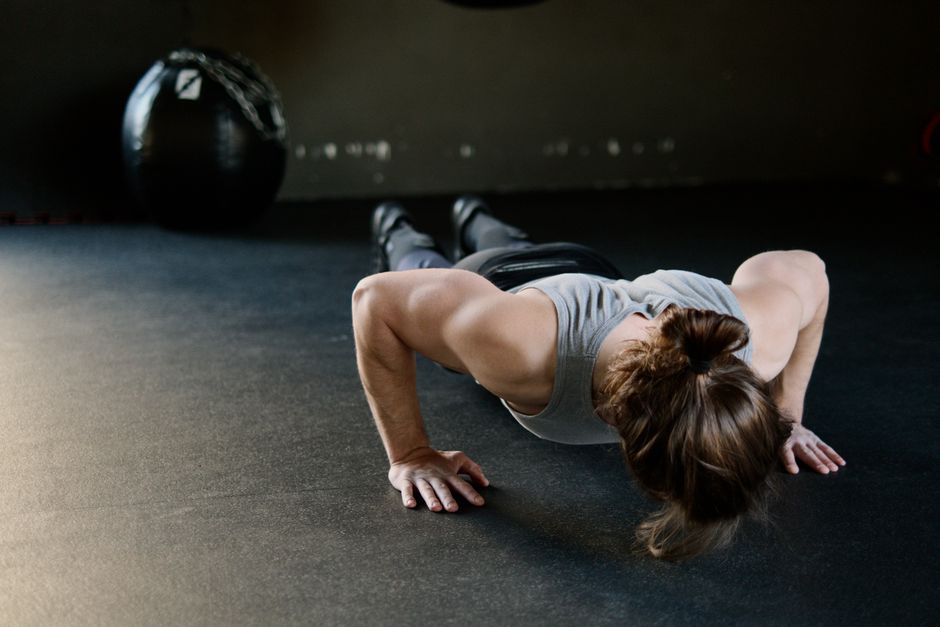
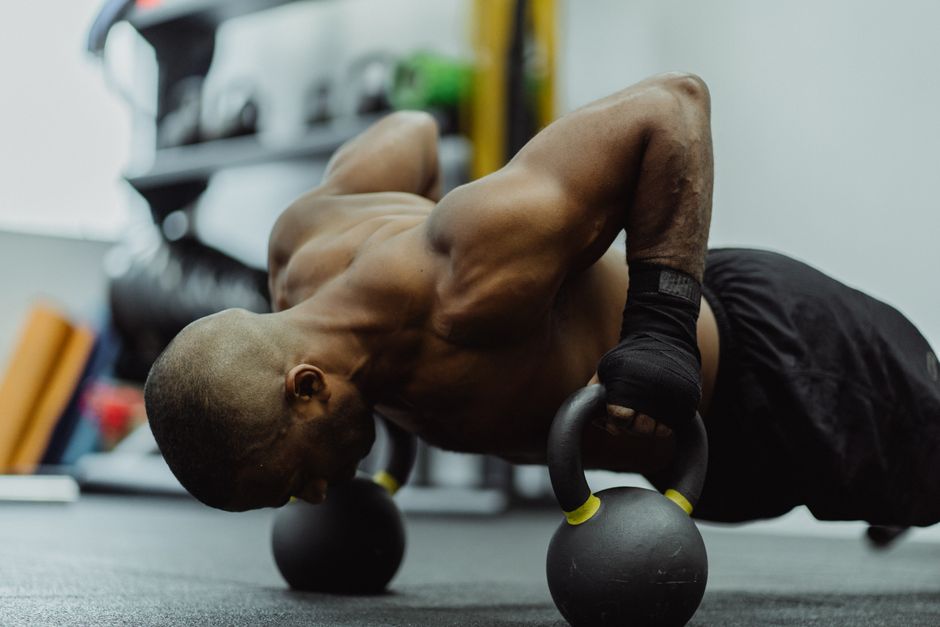
Workout 6 — Renegade Row Complex: Two kettlebells in push-up position. One row left, one row right, one push-up equals one rep. Six to eight reps per set, four sets total. Use flat-bottomed bells — Rogue Competition Kettlebells are ideal here. Round-bottomed cast iron creates a wobble that shifts demand from anti-rotation core to grip, which defeats the entire purpose. Hips must not rotate more than a few degrees during the row.
Workout 7 — Farmer’s Carry Burnout: Carry two heavy bells 40 meters, set them down, rest exactly 45 seconds. Repeat six times. This is a finisher, not a standalone session. By set four, the lower traps begin to fatigue — if your shoulders visibly elevate, stop at five sets. Carrying past trap failure shifts stress to the cervical spine. Titan Fitness cast iron at 2x32kg (men) / 2x24kg (women) is cost-effective for carries since competition-grade bells offer no performance advantage in a loaded walk.
The Weekly Schedule That Actually Works
Four sessions per week, not seven. Workouts 1 and 2 on Monday. Workouts 3 and 4 on Wednesday. Workouts 5 and 6 on Friday. Workout 7 as a finisher on Wednesday or Friday. That’s not a simplified version of the program — that is the program. Running seven high-demand sessions in seven days is how athletes train harder for months while adapting less than someone running four sessions with genuine recovery between them.
Whoop 4.0 or Oura Ring 4 provides HRV-based recovery scoring that removes the guesswork from day-to-day training decisions. At four-plus kettlebell sessions per week, subjective feel routinely underestimates accumulated fatigue.
Which Kettlebells Actually Matter for These Workouts
Competition bells vs. cast iron — where the difference is real
Competition kettlebells — Rogue, Kettlebell Kings, Eleiko — maintain a fixed handle diameter regardless of weight. For the snatch EMOM and flow sequence, this keeps hand positioning consistent when you’re moving across weights mid-session. Cast iron bells grow wider and taller as weight increases, which changes snatch insertion point and rack position between sizes.
For press ladders, carries, and renegade rows, cast iron performs identically to competition bells and costs 30–40% less. Rep Fitness and Titan Fitness carry quality cast iron in the 24–40kg range for $80–$130 per bell — no reason to spend more for those specific protocols.
Do you need a full matched set?
Only for Workouts 1 and 6, which require two bells simultaneously. Everything else runs with a single bell. If budget is the constraint, one Rogue 32kg competition bell and one cast iron 24kg covers five of the seven workouts without matched pairs — and that’s a smarter starting investment than buying a complete rack you won’t use evenly.
Film your two-hand swing from the side before adding any of these workouts — if your lower back rounds at the hinge, nothing above will help you, and several will hurt you.
Medical Disclaimer: This content is for informational purposes only and does not constitute medical advice. Always consult a qualified healthcare professional before making health-related decisions.